When your brand name is holding back your growth
02.06.2026 · Insights · 8 min. read
02.06.2026 · Insights · 8 min. read
Bram De Schepper, Brand Activator
Since this summer, Ghent has a new sweet spot: the B2C concept by Confiserie Larmuseau. At Mellum, artisanal gelato and Belgian confectionery come together in a world full of flavour.
When launching the brand, the question was not how to reach the widest possible audience, but which audience we wanted to win over first. We deliberately chose Gen Z. Not because young people are Mellum’s only or primary target audience, but because a brand that starts gaining traction with them is more likely to catch the attention of other generations and organically find its way to a broader audience.
While Mellum builds on more than a century of craftsmanship, its outlook is firmly focused on the future. With classics such as Babelutten and Ghent snowballs in the range, there was an important challenge to tackle: making traditional treats relevant to a new generation. Winning over Gen Z was therefore not only key to the launch, but also essential to carrying the heritage behind the brand into the future.
And Gen Z is an interesting audience for bringing a new brand to life. Young people are quick to pick up new flavours, places and brands and help shape what becomes culturally relevant. What they discover and share can then spread organically to other audiences. Their consumption habits are also less fixed. There is not always an established favourite spot that first needs to be knocked off its pedestal. Win a place with Gen Z and you not only build a young fanbase, but also increase the chances of the brand being picked up beyond it.
There is another strategic advantage too: a young brand image can broaden more easily than an established, older image can be rejuvenated later on. A brand that feels relevant to young people from the start can naturally grow towards friends, parents and other generations. The reverse is much harder. Once a brand is labelled as “something for my parents”, that perception can be difficult to shake.
Before Mellum had served a single scoop of gelato, we had already started building visibility and curiosity among a younger audience. Instagram and TikTok were the ideal playgrounds, with organic short-form video as the main format.
No polished product shots, but informal and authentic content that felt as if you were watching from the front row. Behind-the-scenes footage, the story behind Mellum and its founder, the connection with Ghent: each piece revealed something new, introducing people to Mellum’s offer and, more importantly, to the people behind the brand.
That human face matters. Young audiences expect brands to behave online as more than a logo or a collection of products. By giving Mellum a recognisable personality before opening day, we started building familiarity early on.
For a young audience, a brand with a face is not a nice extra. It is a basic expectation.
 Video: CASE MELLUM SFEER GIF
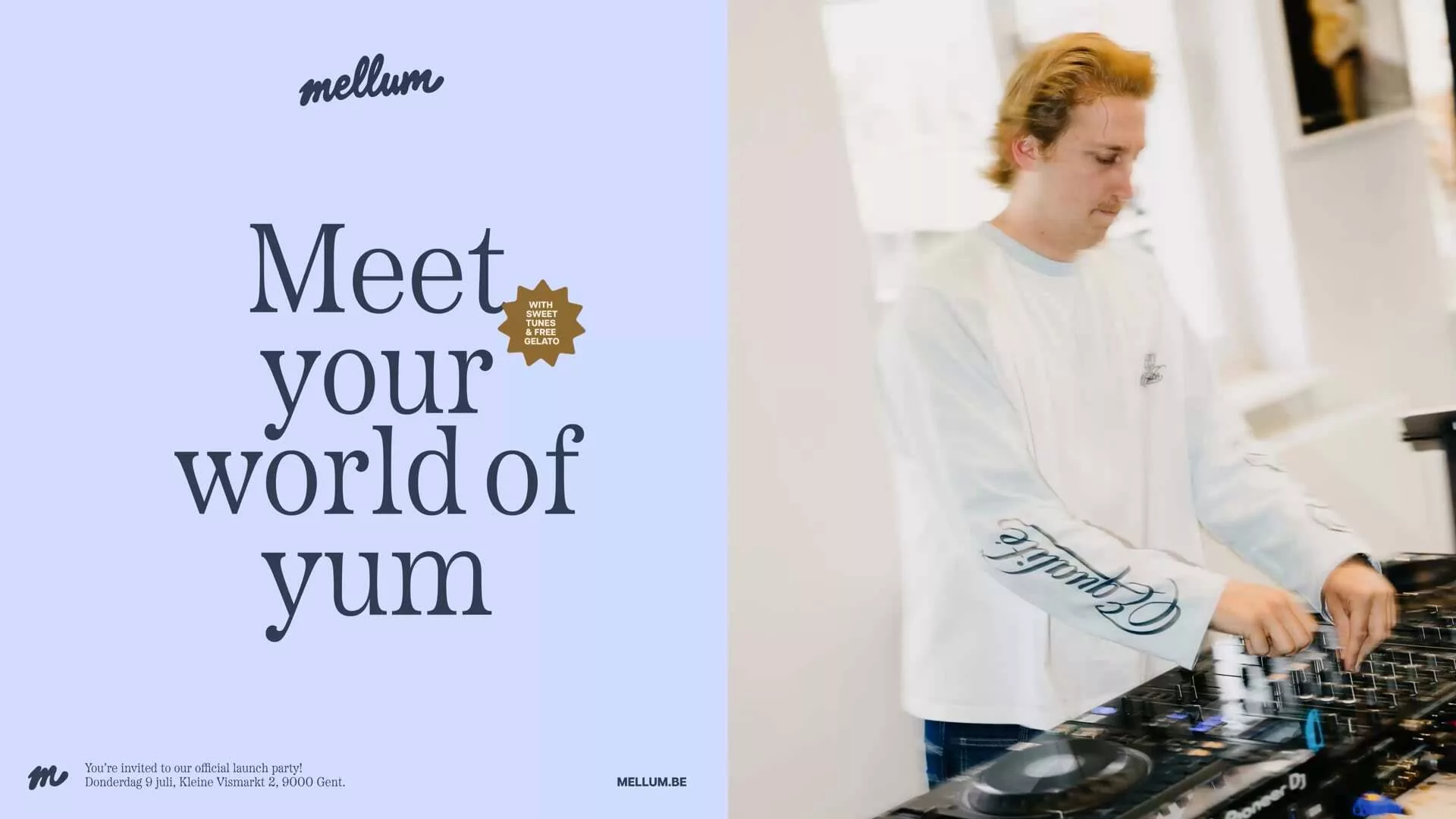
Once curiosity had been sparked, it was time for the real-life experience. More than simply marking the opening of a new store, the launch event had to make Mellum’s essence tangible: bringing people together around something delicious. So we gave visitors plenty of reasons to stop by, including a live set by Simon Wauman, a.k.a. DJ Unregular. Not a random choice. Unregular performs at festivals for young audiences and is known for contemporary sets filled with nostalgic remixes. A combination that fits Mellum’s modern character and its nod to familiar flavours. Unregular has also built a reputation for creative pop-up sets in unexpected locations, from bakeries to sports clubs. A perfect match for Mellum’s ambition to become more than a shop: a place where something is always happening.
We extended that experience beyond Mellum’s walls through a collaboration with Gen Z creators Seba and Djani. Rather than asking them to produce scripted promotional content, we invited them to share a spontaneous day-in-the-life video that included their visit to the opening event. For a young audience, experiencing something through someone else often works better than traditional advertising. The two activations therefore complemented each other perfectly: Unregular gave young people a reason to be there, while Seba and Djani allowed those who were not there to experience part of the opening too.
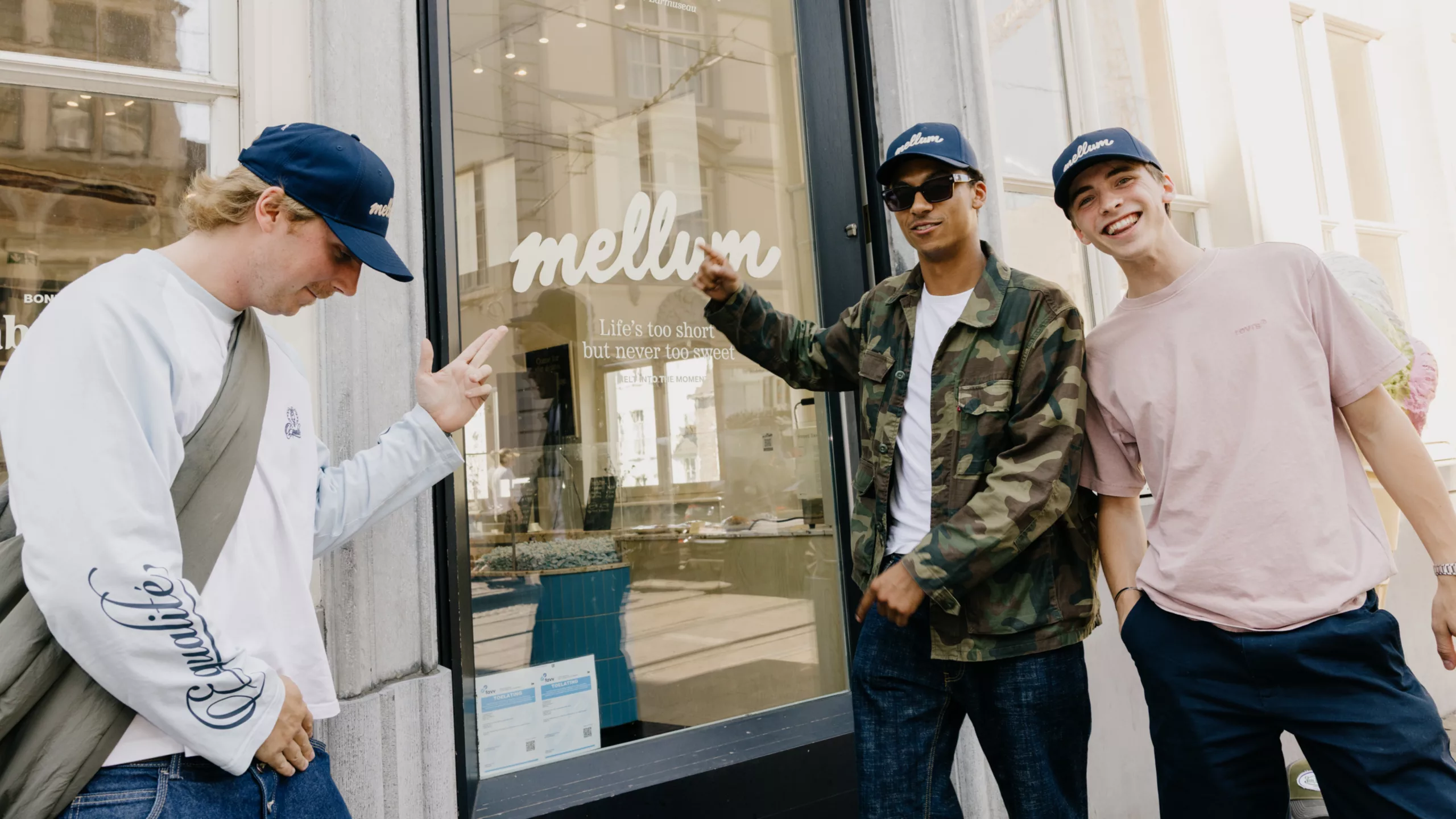
The content created by Seba and Djani immediately showed how young people can act as a springboard towards a broader audience. The briefing was simple: do not start from the product, start from connection. Both creators naturally built bridges to other generations. Djani brought along his hard-to-convince mum, while Seba had his brother and sister taste Mellum products and share their reactions.
The result was relatable content for their own followers that also resonated with a wider audience. Exactly what we had hoped to achieve by starting with Gen Z and allowing the brand to spread from there.
We continued that broader approach during the Ghent Festivities. Through street interviews, we brought Mellum directly to the people of Ghent, from young festivalgoers to older passers-by. Tastings, quick questions and mini-games gave us different content formats, but the idea remained the same. Not simply: what are you tasting? More importantly: who or what moment does this flavour remind you of? Once again, the focus shifted from product to connection, allowing Mellum’s message to take shape with a broader audience.
The numbers also show that the Gen Z strategy generated reach. From late June to late August, organic posts and ads on Instagram generated around 2 million views, at an average CPM of €0.98. On TikTok, we also recorded an average watch time of 7 seconds. Young people were the starting point of the content strategy, but thanks to the chosen formats and stories, the reach did not remain confined to one age group.
The Gen Z activation was always intended as a stepping stone, not an end point. We have since moved into the next phase with a second wave of influencers, this time targeting a broader and older audience. It is still too early to share results, but the direction is clear: we are building on what the first phase has already shown. Starting young does not have to limit a brand. It can open the door to other generations.
The lesson is not simply “target young people”. A specific segment of your audience can, also from a cost-efficiency perspective, help carry your brand launch. For a brand like Mellum, young people may not be the largest group of buyers. But they are quick to pick up new stories, share them easily and bring them into their immediate environment. That means young audiences can be more than a gateway to broader reach. They can also become credible messengers for the brand. When a brand speaks directly to an older or broader audience, it has to prove its own relevance. Through younger audiences, that validation can come from within people’s own circle: a son taking his mother along, or a brother letting his sister have a taste. That kind of validation cannot be bought through media spend alone. It happens when both the content and the brand itself strike the right chord.
At Mellum, we developed this approach step by step, from the initial briefing and content to the campaigns that are now broadening the audience further. The key is not to start as broadly as possible. It is to make a conscious choice about where your brand has the best chance to start coming to life.
Discover more about our work for Mellum or get in touch to talk about your brand.
02.06.2026 · Insights · 8 min. read
23.04.2025 · Insights · 5 min. read
18.02.2025 · Insights · 6 min. read